

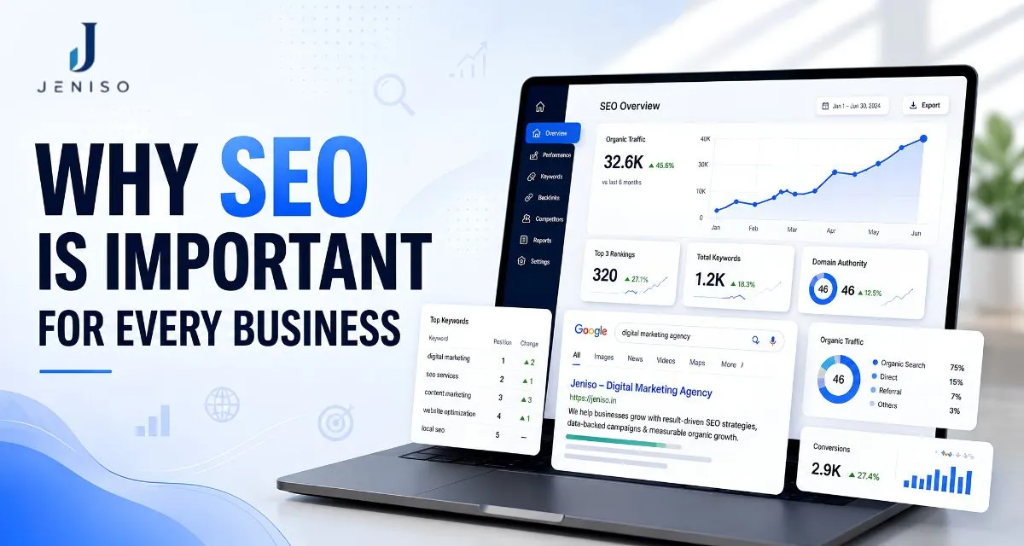
A few months back, a client came to us convinced his website was broken. Beautiful design, fast loading, all the right pages. Not a single enquiry in three weeks though. Turned out nothing was broken at all — the site just didn't show up anywhere on Google for the things people were actually searching. It existed. It just wasn't findable. Same as not existing, really, when you think about how people shop now.
Because that's how most of us behave. Need a plumber, a laptop, a dentist — you don't call around anymore, you Google it and pick from the first handful of results. Nobody's flipping through page three. If your business isn't sitting somewhere near the top, you're basically handing that customer to whoever is.
That's the whole reason the importance of SEO for business keeps coming up in every marketing conversation these days. Not because it's trendy. Because it's become the difference between getting found and getting skipped.
What Is SEO and Why Does It Matter for Businesses?
SEO — Search Engine Optimization — is just the work of making your website something Google trusts enough to put in front of people. Google's whole job is sorting through billions of pages and handing back the ten or so that seem most useful for whatever someone typed in. It looks at a huge pile of signals to decide this: is the content actually relevant, does the page load fast, do other trustworthy sites link to it, do visitors stick around once they land there. SEO for business is really just the practice of nudging all those signals in your favor instead of leaving them to chance.
People sometimes mix this up with paid ads, but they're not really the same animal. Ads buy you a spot at the top for as long as the money keeps flowing. SEO earns that spot because Google has decided, on its own, that you deserve it. Stop paying for ads and the traffic vanishes overnight. Stop actively working on SEO and, honestly, you'll still coast on the results for a while.
Importance of SEO for Business Growth
A few things happen once a business starts taking SEO seriously.
First, you start showing up in front of people even when they don't click. Sounds small, but it isn't — every time your name appears in search results, it builds a little bit of familiarity, and familiarity is half the battle before someone ever picks up the phone to call you.
Then there's the traffic itself, which is a different beast entirely from what you get through ads. Someone typing "best interior designer in Dehradun" into Google isn't scrolling for fun. They're mid-decision. Compare that to someone who clicked an Instagram ad between two reels — completely different level of intent, and it shows in how many of them actually convert.
Ranking well also does something quieter: it makes you look credible. Nobody says this out loud, but most people subconsciously trust a business that shows up on page one more than one they had to dig for. It's a strange little psychological shortcut, and it works in your favor if you're the one ranking.
And then there's the part that convinces most business owners once they actually see it happen — SEO keeps paying off long after the work is done. A blog post from eight months ago can still be quietly bringing in visitors today. Try saying that about an ad campaign that ended in April.
How SEO Helps Different Types of Businesses
Small businesses probably benefit the most, oddly enough — SEO doesn't care about your budget the way ads do. A local shop that's done the work right can genuinely outrank a much bigger competitor for the searches that matter in its own city.
E-commerce is a different story. There, it's mostly about whether individual product pages show up when someone searches for that exact item. If they don't, the product might as well not be listed at all.
Service businesses — clinics, consultants, law firms, agencies — lean on SEO to keep enquiries coming in steadily, instead of depending entirely on referrals, which tend to slow down the moment things get quiet.
And local businesses need to show up on the map. Literally. Someone searching "cafe near me" isn't reading through five pages of results before deciding where to get coffee.
Key SEO Strategies That Help Businesses Grow
Most people picture SEO as one single thing you either do or don't do. It's really five or six things, and skipping any one of them tends to drag the rest down with it. Understanding the Importance of SEO for Business helps companies build a strong online presence and achieve long-term growth.
- Keyword research comes first, every time: Before writing anything at all, you need to know what people are actually typing into Google — and how hard it'll realistically be to rank for those exact words.
- On-page SEO: Everything that lives on the website itself: titles, meta descriptions, how the content's structured, how pages link to one another so both visitors and Google can navigate around without getting lost.
- Technical SEO: The unglamorous bit nobody wants to talk about — site speed, mobile behaviour, whether Google can even crawl your pages properly. Ignore this and months of good content work quietly goes to waste.
- Content marketing: Fills in the rest. Blogs, guides, FAQs — anything that genuinely answers a question a customer might type in. Done well, it ranks and it makes you look like you know what you're talking about, which, let's be honest, isn't nothing.
- Local SEO: Rounds it off for anyone serving a specific city or region — Google Business Profile, local citations, reviews, the whole map-pack game.
SEO or Paid Ads? Probably Both
| SEO | Paid Ads |
|---|---|
| Builds up gradually and keeps compounding | Works only for as long as the campaign runs |
| Traffic keeps arriving after the work's done | Stops the day the budget runs out |
| Slowly builds credibility over time | Buys attention, not necessarily trust |
| Traffic tends to stay steady | Rises and falls with how much you spend |
Ads are great for a quick burst — a launch, a sale, some kind of limited window. But businesses that rely only on ads tend to be starting from zero every single time they pause.
SEO takes longer to kick in, no question, but once it does, it doesn't just disappear the second you stop staring at the dashboard.
Why Choosing the Right SEO Partner Matters
SEO isn't a one-and-done kind of task. Google's algorithm keeps shifting, competitors keep adjusting, and the strategy that worked last year probably needs tweaking this year. So the agency or freelancer you bring in matters almost as much as the decision to invest in SEO at all.
If you're comparing options for the Best Digital Marketing Company in Uttarakhand, skip the flashy pitch decks and ask about actual numbers — rankings they've moved, traffic they've grown, how often they actually report back to clients. A decent partner should be able to show real work, not just promise a vague "we'll get you to page one."
Same logic applies if you're specifically looking for an SEO Company in Haldwani — local know-how counts for a lot here, since ranking for a regional market plays out differently than chasing national keywords.
At Jeniso, this is roughly how we work with every client: figure out what you're actually trying to achieve first, then build the strategy around that — not run the same template we used for the last five businesses that walked through the door.
Common SEO Mistakes Businesses Should Avoid
- Jumping straight into writing without ever checking what people search for
- Publishing something just to have "posted this week," with nothing useful in it
- Treating mobile as an afterthought when most searches now happen on a phone
- Brushing off slow load times and broken links as "just technical stuff, not urgent"
- Quitting after six weeks because rankings haven't moved yet
That last one is probably the most common, and honestly the most expensive mistake on this list. SEO rewards people who stick around longer than the ones who don't.
How to Start SEO for Your Business?
Realistically, it looks something like this:
- A proper audit of where the site currently stands
- Real keyword research, not guesswork
- A look at what's working for the competitors currently outranking you
- Fixing and building out content around the keywords that matter
- Cleaning up whatever technical issues are dragging things down
- Tracking rankings and traffic month over month, adjusting as you go
None of it is particularly exciting. It's mostly just consistency, stacked over time.
Conclusion
SEO isn't optional anymore, not in any real sense. It decides whether people find you, whether they trust what they find, and whether that trust eventually turns into a paying customer. Businesses that stay with it tend to look completely different a year later compared to the ones chasing quick wins through ads and hoping something sticks.
If you're ready to actually get found instead of just having a website that sits there — that's the kind of work we do at Jeniso. Happy to take a look at where you currently stand and tell you honestly what it'd take to move things forward.
Ready to rank higher and drive real business growth?
Let's discuss a tailored SEO strategy engineered specifically for your business goals.
Get in Touch with JENISO